In the article, “Seabin using plastic to fight plastic”, Seabin Project states that micro plastics and micro fibers threaten marine ecosystems as they accumulate pollutants rapidly and animals could mistake them as food. Measuring less than 5mm in diameter, they are similar in size as prey for marine organisms and might end up in the food we consume. The threat is so severe that the UN has called for action.
The Seabin Project (2019) uses Seabin technology to remove pollutants such as micro plastics and micro fibers in the water. According to the Seabin Project, with some modifications to the filter, monitoring and sampling pollutant contents will be cheaper and more time efficient compared to standard methods, and runs continuously. Besides developing technology to better intercept pollutants, the Seabin project also invests in education and scientific initiatives to reduce the amount of pollutants in the ocean.
Final blog post.
When I first started this module, I was unsure of how this module would be like. I started the course expecting it to be one of those modules without much impact.
However, with more lessons, I feel that I have managed to tackle upon my weaknesses that I have expressed concern in my introduction. For instance, I had always been struggling with presentations. In the past, I would end up stumbling on my words and end up panicking. However, through this course, I have learnt to keep myself calm regardless of the situation and to learn to enjoy the process.
To add on, I have seen improvements to my written proficiency. Before the start of this module, I was prone to making sentence structure errors in my written essays. To say that all errors have been eliminated is impossible, but there had been much fewer errors made since.
Last but not least, I feel that the professor has made the module much more enjoyable. He manages to entertain the class in his own unique way and makes it such that everyone learns something each lesson.
For the group project, I feel that I have gained much more than my expectations. Initially, I had assumed that it would be just another typical research project. However, my groupmates were dedicated to our chosen project, which in turn kept me motivated throughout the course. Additionally, by participating in the Mapletree Challenge, I learnt that there are many factors that are needed in order to ensure success. For instance, everyone had to perform extensive research on all factors involved in the project, such as the mechanical properties of plastic and carbon fibre. We also had to learn to coordinate our efforts into areas that required more attention, such as designing the slides such that they were easy to digest yet leave a memorable impact on the viewers.
This group project has taught me that only a coordinated group effort will we be able to conduct successful group research. As we were able to delegate tasks quickly, we were able to gather relevant information at a faster rate as compared to other groups. This allowed us to be able to better refine our project such that it was able to meet our professor’s expectations.
As they say: So long, and thanks for all the fish! 🙂
Technical report draft 1


An Affordable Carbon-Fiber Bicycle For The Masses
Team name: Lapis Bikes
Lecturer: Professor Brad Blackstone
Module: MEC1281
Date:
| Group Members: | Matriculation No: |
| Zulhusni (Leader) | 1901740 |
| Hilmi | 1901699 |
| Yong Wei | 1901761 |
| Yong Xun | 1901704 |
Proposal
Contents
Executive Summary
Introduction
Background
Problem Statement
Purpose Statement
Proposed modification
Benefits
Evaluation
Limitations
Methodology
Concluding Statement
References
Appendix: A
Boi.
Executive Summary
Background
Today, the cost of a carbon fibre bicycle ranges from $2000 to upwards of $10,000. A majority of the costs incurred is due to the research and development required to develop these bicycles for the market.
According to Becker (2018), the cost of a mold of a carbon fibre bicycle “costs between $60,000 and $100,000 depending on a number of variables”. The high costs are due to a number of factors. Firstly, in some production methods, molds are subjected to high pressure and temperatures. As a result, these molds need to be made out of strong materials that can withstand such pressures and temperatures without deformation. In addition, costs can be driven up due to the complexity and design tolerance of the design. The more complex the part to be produced is, the more complex the mold will be. Tighter design tolerances for some of the parts of the design will also require more precise molds to be produced. Once produced, molds are impossible to modify, hence requiring another mold should there be any changes to the design. If multiple iterations are required the costs are further increased.
In standard carbon fiber production, the carbon fibre mold is required to undergo high temperatures in order to bind the resin and carbon together. This process requires a huge amount of heat, which is necessary to burn off the non-carbon molecules in the chemical, which requires a large amount of energy. Energy is expensive, and manufacturers must use a massive amount of energy to bring internal oven temperatures to the thousands of degrees necessary to force this chemical process. Additionally, non-carbon molecules are industrial pollutants and must be carefully—not to mention, expensively—disposed of in order to prevent pollution.
Another reason for the high cost is the manufacturing methods adopted by companies. These include unidirectional prepreg, resin transfer moulding and filament winding.
The most popular method would be unidirectional prepreg method, due to the higher specific properties and a more straightforward specific fibre angle lay-up. To make the carbon fibre weave, a lot of manpower is required, thus increasing costs.
Resin transfer molding is a closed-mould process for medium-volume manufacturing. Molds typically consist of matching metal tools into which a dry fibre preform is inserted. The mold is then closed and clamped shut before pumping resin into the tool cavity to thoroughly wet-out the fibres. It will then be heated to cure the resin, after which the part can be removed from the tool.
For filament winding, construction starts with dry fibre, where fibre tows pass through a resin bath and wound at various angles onto a speed-controlled rotating mandrel, controlled by a fibre feeding mechanism.
All these are complicated processes involved in manufacturing carbon fibre bikes, which results in high costs. The cost of carbon fibre is still expensive for mass manufacture. According to a report by Meredith, J. et al (2015), the cost of carbon fibre is USD 8.31/kg, as compared to steel and aluminium at USD 0.39/kg and USD 1.75/kg respectively. As such, the costs of carbon fibre bicycles will also be more expensive.
The ideal bike frame is a sustainable carbon fiber frame made through eco- friendly manufacturing process while maintaining the same performance.
Problem Statement
Current bike frames in the market are too expensive to manufacture due to tooling and R&D cost. Also, materials such as aluminium and carbon fiber are used excessively and wastefully due to current machining techniques
Purpose Statement
The purpose of this report is to introduce the concept of 3D printed carbon bikes and molds to independent bike companies that do not have the budget required to compete with other companies in terms of R&D cost. This way they are able to construct a bike without having to invest too much money into it
Problem Solution
A hybrid carbon fibre frame coupled with 3D printed sandwich structure created from a 3D printed mould.

Figure 1. Rendering of proposed bike frame
3D printed sandwich structure
A sandwich composite structure is composed of a core material, that is sandwiched between two pieces of composite fiber layers. This structure is used widely in aerospace, naval and automotive applications due to their high stiffness/weight and strength to weight ratio. According to Li,. et al(2017), Conventional honeycomb cores are mainly used in applications due to their superior properties over its foam core. They stated that they were able to show the correlation flexural stiffness and strength as the relative density of the core material increases. Through this insight, we can safely say that we are able to tune the stiffness and the strength of our frame through the use of a sandwich structure. By implementing 3D printing technology, we can optimise the topology of the core with relation to the forces that the component will experience. WIth this, we can keep the carbon fiber layup as simple as possible. We can further optimize the core, by using different types of thermoplastics. Different thermoplastics have varying properties that we can take advantage of. For example, Polyethylene terephthalate(PETG) has excellent impact resistance or Nylon that is durable and wear-resistant. Using a blend of thermoplastics, we can alter the characteristics of the bike frame to however we want it to function.
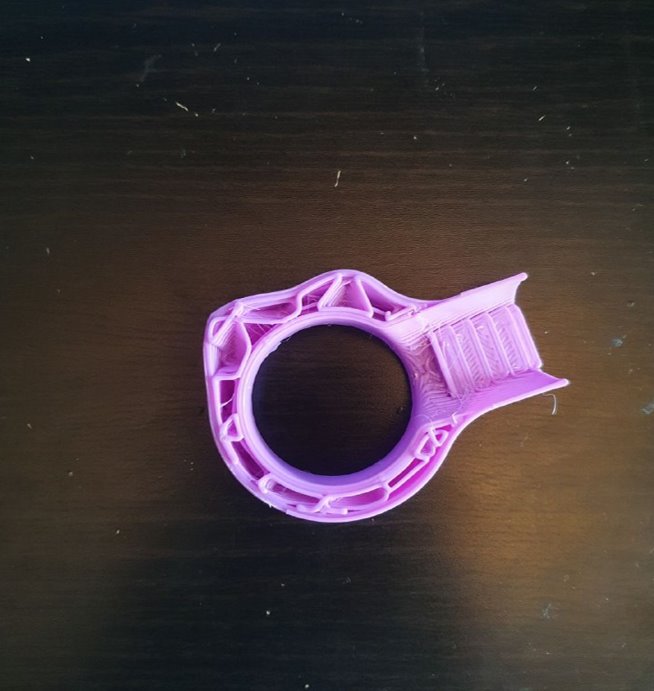
Figure 2. Cross section of a 3D printed core material that goes into the bottom bracket
3D printed mould
A 3D printed mould will reduce the tooling cost, as we will be moving away from aluminium as the raw material and instead replace it with a thermoplastic. According to ClintonAluminium(2017), they stated that 7075 Aluminium, Aircraft grade, is used extensively for prototyping tooling moulds. According to MidWestSupply.com, 7075 Aluminium costs $20,984 USD/m3. In contrast, the thermoplastic material only cost (insert price here). Using 3D printed technology, further optimization can be made to reduce the amount of material being used. By only reinforcing the parts of the mould that will undergo stress, further reduction of the material used in the mould can be done.
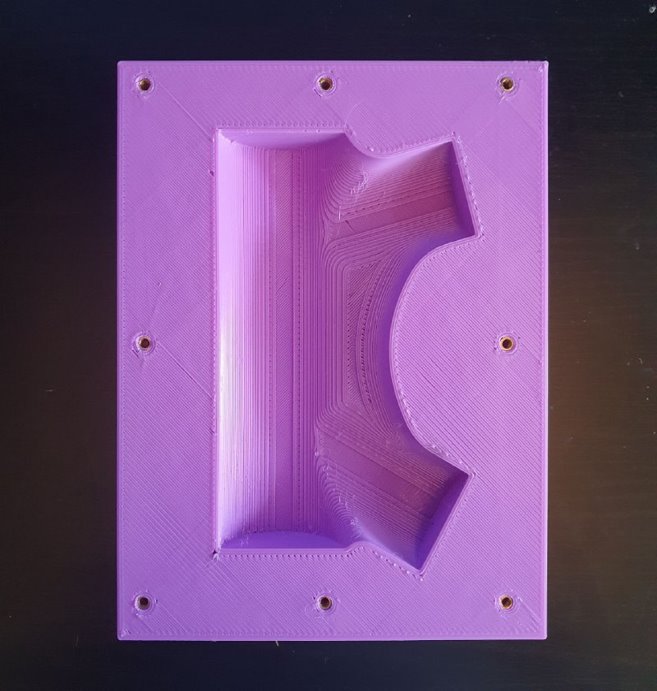
Figure 3. Female 3D printed mould
Manufacturing Process
The manufacturing process that we are proposing will use elements of the above mentioned processes. By combining the use of the 3D printed moulds and cores, we are able to manufacture a bike that has the stiffness properties of a full carbon fiber bike, without the high cost of tooling and R&D. The proposed process is that the designer of the bike has to take into account the forces that the bike frame will undergo. From here, using Finite Element Analysis, we are able to simulate forces that the bike will undergo. Using this data, the designers are able to design a 3D printed core with the required density that is needed. Penultimately, the designer just has to add layers of carbon fiber weave. Lastly, all of this materials will then be consolidated using the 3D printed mould, that will provide the compression force that the carbon fiber needs.
Benefits
Sustainability
One benefit of this method of manufacturing process is the reusability of the moulds. As moulds are made from thermoplastics, used moulds can be re-melted back and reused to make new moulds. This method reduces the amount of wastage as the 3D printed parts can be reused to create new iterations of designs. According to Tian (2017), “continuous carbon fiber and PLA matrix was recycled in the form of PLA impregnated carbon fiber filament from 3D printed composite components and reused as the raw material for further 3D printing process.” Even after reusing the thermoplastics, materials such as continuous fiber reinforced thermoplastic composites (CFRTC) showed no compromise during the recycling process. Instead, the material gave an increase in 25% higher bending strength than its original form.
Reduced Cost
As stated above, 3D printed moulds can reduce the tooling cost. This manufacturing process allows lesser wastage compared to conventional processes such as Computer Numerical Control(CNC) machining. For example, products made from CNC came from a block of aluminium. The block of aluminium is then machined down to its specified dimensions to create the product. Excess materials may be recycled but it requires high amounts of energy to recycle.
(- r&d cost)
Limitations and Evaluation
There are two categories of cyclists. The first being a serious athlete, whereby every milligram shaved off his bicycle contributes greatly to his performance. Next would be a cyclist who enjoys the sport but does not take part in competitive racing. A hybrid carbon fibre frame at half the price of the commercial carbon fibre bicycle at the slight expense of weight would be sure to appeal to the second group of cyclists.
Despite the reduction in cost, the hybrid carbon fibre frame coupled with 3D printed sandwich structure will experience an increase in weight due to the addition of the core material. This unfortunately will bring down the performance of the bicycle.
However, weight is just one factor taken into consideration. The choice when buying a new bicycle involves other factors such as the feel, stability, comfort, geometry of bike, sizing, aesthetics, functions and presence of mounting holes in the frame. In addition, we could focus more on gravel bicycle, where weight is not such an important factor.
When it comes to a new product, everyone will have their doubts if the product is truly credible. This is especially the case for our product because our core material is plastic. When it comes to plastic, the word strong and sturdy does not come to mind. It will instill doubt on whether the frame is truly as sturdy as stated.
However, a series of tests on our hybrid carbon fibre frame such as the rockwell hardness test, lateral load fatigue test, falling mass fork impact test etc, with comparison video to the other more commercialized frame will allow customers to have greater faith in our product.
Methodology
Secondary research sources were used as a reference to obtain relevant information for the completion of the report. In addition, prototypes were also developed as a proof of concept. FEA (finite element analysis) using ABACUS was also done to simulate the forces acting on the components.
Secondary Research
A thorough research on the materials used and the printing method was conducted in order to determine the best combination for the production of the bicycle structure and mold. The team used manufacturer websites and secondary sources to back up our findings. We used official product websites to get the pricing of the bicycles to set it as a benchmark. Secondary sources were then used to explain the high costs of traditional carbon fibre bikes, and to explain the advantages and disadvantages of using 3D printing technique.
Concluding Statement
This manufacturing process is still in its infancy stage, and requires more time and research to be a fully viable solution. In its current stage, we are able to 3D print the core and the mould. More simulations and optimisations needs to be done, in order to find a perfect ratio of plastic core to carbon fiber. However, when it is fully realised, we will arrive at a bike frame that is sustainable for the environment, and a cheaper alternative to full carbon fiber bikes.
References
Becker, K. (2018, May 18). Carbon Fiber Bike Frames May Become A Whole Lot Cheaper. Retrieved March 2, 2020, from https://www.digitaltrends.com/outdoors/arevo-3d-printed-bike-frame/
Carruthers, J. (2018, April 25). What is Resin Transfer Moulding (RTM)? Retrieved March 2, 2020, from https://coventivecomposites.com/explainers/resin-transfer-moulding-rtm/
Filament Winding. (2019, January 24). Retrieved March 2, 2020, from https://netcomposites.com/guide/manufacturing/filament-winding/
How carbon fibre bicycle frames are made. (2018, January 4). Retrieved March 2, 2020, from https://cyclingtips.com/2018/01/how-carbon-fibre-bicycle-frames-are-made/
Li, T., & Wang, L. (2017). Bending behavior of sandwich composite structures with tunable 3D-printed core materials. Composite Structures, 175, 46–57. doi: 10.1016/j.compstruct.2017.05.001
Meredith, J., Bilson, E., Powe, R., Collings, E., & Kirwan, K. (2015). A performance versus cost analysis of prepreg carbon fibre epoxy energy absorption structures. Composite Structures, 124, 206–213. doi: 10.1016/j.compstruct.2015.01.022
Renner, L. (2018, December 10). The Rise of Carbon Fiber. Retrieved March 2, 2020, from https://blog.propelx.com/what-is-carbon-fiber/
Swaby, R. (2013, June 17). Why Is Carbon Fiber So Expensive? Retrieved March 2, 2020, from https://gizmodo.com/why-is-carbon-fiber-so-expensive-5843276
The Best Aluminum Alloys For Molds. (2017, May 22). Retrieved from https://www.clintonaluminum.com/the-best-aluminum-alloys-for-molds/#:~:text=6061
Why Are Injection Molds So Expensive? – Reading Plastic. (2019, March 29). Retrieved March 2, 2020, from http://readingplastic.com/why-are-injection-molds-so-expensive/
https://www.sciencedirect.com/science/article/pii/S0959652616320017 (Sustanaibility)
https://www.emerald.com/insight/content/doi/10.1108/RPJ-07-2013-0067/full/html (Reduced Cost)
Annotated Summary final
Tian, X., Liu, T., Wang, Q., Dilmurat, A., Li, D., & Ziegmann, G. (2017). Recycling and remanufacturing of 3D printed continuous carbon fiber reinforced PLA composites. Journal of Cleaner Production, 142, 1609–1618.
doi: 10.1016/j.jclepro.2016.11.139
In this article, it primarily focuses on a more environmentally-friendly production of carbon fiber reinforced thermoplastic composites, by the “recycling and re-manufacturing of 3D printed carbon fiber reinforced PLA composites”. This method of production involves impregnating the carbon fiber into a thermoplastic meld in a regularly arranged manner, and then re-melting and gently pulling the matrix material continuously using a hot air gun to produce new filaments. This process created a new filament which exhibited “25% higher bending strength” and higher tensile performance compared to the original printed composites, despite some signs of aging within the PLA composite. With a 100% recovery rate for the carbon fiber and 73% for the PLA matrix during recycling, it allows a potential method for large scale, low-cost fabrication of recyclable composites.
This article provides a useful source of information for our research project on the use of 3D printing to produce a bicycle. Not only does the article show that the carbon fiber and PLA composite material can be recycled to a large degree, it also shows that the new combined material exhibits mechanical properties that surpass that of its original printed composites. This means that not only will 3D printed bicycles be more environmentally friendly, but they will also be as strong, if not stronger after recycling. While the experiment in this article only involved a small amount of material, it still provides us with useful information about the potential of using recycled 3D printing materials in the production of 3D printed bicycles.
Design Summary Analysis
In the article, “Seabin using plastic to fight plastic”, Seabin Project states that micro plastics and micro fibers threaten marine ecosystems as they accumulate pollutants rapidly and animals could mistake them as food. The threat is so severe that the UN has called for action. The Seabin Project (2019) uses Seabin technology, which is designed to remove pollutants such as micro plastics and micro fibers in the water with a small adaptation to the standard Seabin filter. According to the Seabin Project, with some modifications to the standard Seabin filter, monitoring and sampling pollutant contents will be cheaper and more time-efficient as compared to the standard method of using a “manta trawl” to collect samples, runs continuously, and is also shown to be equally effective. Besides developing technology to better intercept pollutants, the Seabin project also invests in education and scientific initiatives to reduce the number of pollutants in the ocean.
Although it does not collect as much waste as compared to The Ocean Cleanup Project, it is however more cost-effective in combating micro plastic pollution and has a greater community outreach.
One of the advantages of using Seabins is the lower operating costs required. According to Myers (2018), the cost of each Seabin was “approximately $4,100 each”. As Seabins are more affordable and requires minimal labour required as compared to The Ocean Cleanup Project, this would allow greater deployment of Seabins across coastal areas, and in turn, increase the amount of marine waste collected before they accumulate in open waters.
Another advantage of the Seabin Project is the community outreach of the project. According to the Seabin Project (2019), there has been support from universities and environmental groups globally, with renowned environmental engineers involved to help correlate the data collected, and other partners that are also involved in developing new technologies to improve the Seabins. Additionally, there are programs to encourage the youth to tackle the issue through lessons and hands-on activities. Finally, there has been crowdfunding kits available in countries such as Ireland, New Zealand and Australia that not only allow Seabins to be deployed, but also act as a “communication platform for educational programs and community events”. This shows that the Seabin Project is not only taking an active role in educating the youth about the plastic pollution issue, and inspiring them to help develop solutions in the future, but also collaborating with environmental groups to improve on the solutions.
The Ocean Cleanup Project is however, the better solution to combating plastic pollution. According to The Ocean Cleanup Project (2019), the project employs a passive clean-up system to tackle plastic pollution. Consisting of a floater at the surface to provide buoyancy and a skirt below to trap the waste, it is used to capture plastics through the use of the wind, waves and currents. Once a sea anchor slows down the system, a vessel is then periodically dispatched to remove the plastic. As compared to the Seabin Project, it has the ability to capture more plastic pollution than a single Seabin could, it shows that the Ocean Cleanup Project is more effective in combating plastic pollution.
To conclude, despite the limitations of the Seabins to collect large amounts of plastic pollution, it is however affordable to operate in large numbers and has a greater community outreach as compared to The Ocean Cleanup Project. Such a combination will not only help tackle plastic pollution, but will also encourage people to play their part.
References
Education – Seabin Foundation – The Seabin Project. (n.d.). Retrieved February 9, 2020, from https://seabinproject.com/seabin-foundation/education/
Myers, M. (2018). These garbage cans could clean up the oceans for us. Retrieved 9 February 2020, from https://www.cnet.com/news/seabins-want-to-be-the-garbage-cans-of-the-ocean/
Seabin using plastic to fight plastics. (2019). Retrieved February 9, 2020, from https://seabinproject.com/seabin-using-plastic-to-fight-plastics/
The Ocean Cleanup. (2019). Oceans. Retrieved February 10, 2020, from https://theoceancleanup.com/oceans/
Design Summary Draft 2
In the article, “Seabin using plastic to fight plastic”, Seabin Project states that micro plastics and micro fibers threaten marine ecosystems as they accumulate pollutants rapidly and animals could mistake them as food. The threat is so severe that the UN has called for action. The Seabin Project (2019) uses Seabin technology, which is designed to remove pollutants such as micro plastics and micro fibers in the water with a small adaptation to the standard Seabin filter. According to the Seabin Project, with some modifications to the standard Seabin filter, monitoring and sampling pollutant contents will be cheaper and more time efficient as compared to the standard method of using a “manta trawl” to collect samples, runs continuously, and is also shown to be equally effective. Besides developing technology to better intercept pollutants, the Seabin project also invests in education and scientific initiatives to reduce the amount of pollutants in the ocean.
Although it does not collect as much waste as compared to using traditional methods, it is however more cost-effective in combating micro plastic pollution, and has a greater community outreach as compared to other clean-up projects.
One of the advantages of using Seabins is the lower operating costs required. According to the article “Seabins want to be the garbage cans of the ocean”, the cost of each Seabin was “approximately $4,100 each”. With the cost of each Seabin being affordable and with minimal labour required as compared to traditional methods, this would allow a greater deployment of Seabins across coastal areas, and in turn increase the amount of marine waste collected before they accumulate in open waters.
Another advantage of the Seabin Project is the community outreach of the project. According to the Seabin Project, there has been support from universities and environmental groups globally, with renowned environmental engineers involved to help correlate the data collected, and other partners that are also involved in developing new technologies to improve the Seabins. Additionally, there are programs to encourage the youth to tackle the issue through lessons and hands-on activities. Finally, there has been crowdfunding kits available in countries such as Ireland, New Zealand and Australia that not only allow Seabins to be deployed, but also act as a “communication platform for educational programs and community events”. This shows that the Seabin Project is not only taking an active role in educating the youth about the plastic pollution issue, and inspiring them to help develop solutions in the future, but also collaborating with environmental groups to improve on the solutions.
There are however, other projects that are able to provide a better solution to combating plastic waste. The Ocean Cleanup Project is such an example. The project employs a passive clean-up system to tackle the plastic pollution. Consisting of a floater at the surface to provide buoyancy and a skirt below to trap the waste, it is used to capture plastics through the use of the wind, waves and currents. Once a sea anchor slows down the system, a vessel is then periodically dispatched to remove the plastic. As compared to the Seabin Project, it has the ability to capture more plastic pollution than a single Seabin could, it shows that the Ocean Cleanup Project is more effective in combating plastic pollution.
To conclude, despite the limitations of the Seabins to collect large amounts of plastic pollution, it is however affordable to operate in large numbers and has a greater community outreach as compared to other clean-up projects. Such a combination will not only tackle the plastic pollution, but will also encourage people to play their part.
References:
Seabin using plastic to fight plastics. (2019, February 8). Retrieved February 9, 2020, from https://seabinproject.com/seabin-using-plastic-to-fight-plastics/
Myers, M. (2018). These garbage cans could clean up the oceans for us. Retrieved 9 February 2020, from https://www.cnet.com/news/seabins-want-to-be-the-garbage-cans-of-the-ocean/
The Ocean Cleanup. (2019, December 12). Oceans. Retrieved February 10, 2020, from https://theoceancleanup.com/oceans/
Design Summary Draft 1
In the article, “Seabin using plastic to fight plastic”, Seabin Project states that micro plastics and micro fibers threaten marine ecosystems as they accumulate pollutants rapidly and animals could mistake them as food. The threat is so severe that the UN has called for action. The Seabin Project (2019) uses Seabin technology, which is designed to remove pollutants such as micro plastics and micro fibers in the water with a small adaptation to the standard Seabin filter. According to the Seabin Project, with some modifications to the standard Seabin filter, monitoring and sampling pollutant contents will be cheaper and more time efficient as compared to the standard method of using a “manta trawl” to collect samples, runs continuously, and is also shown to be equally effective. Besides developing technology to better intercept pollutants, the Seabin project also invests in education and scientific initiatives to reduce the amount of pollutants in the ocean.
Although it does not collect as much waste as compared to using traditional methods, it is however more cost-effective in combating micro plastic pollution, and has a greater community outreach as compared to other clean-up projects.
One of the advantages of using Seabins is the lower operating costs required. According to the article “Seabins want to be the garbage cans of the ocean” by Cnet (2019), it was stated in the article that the cost of each Seabin was “approximately $4,100 each”. With the cost of each Seabin being affordable and with minimal labour required as compared to traditional methods, this would allow a greater deployment of Seabins across coastal areas, and in turn increase the amount of marine waste collected before they accumulate in open waters.
Another advantage of the Seabin Project is the community outreach of the project. According to the Seabin Project, there has been support from universities and environmental groups globally, with renowned environmental engineers involved to help correlate the data collected, and other partners that are also involved in developing new technologies to improve the Seabins. Additionally, there are programs to encourage the youth to tackle the issue through lessons and hands-on activities. Finally, there has been crowdfunding kits available in countries such as Ireland, New Zealand and Australia that not only allow Seabins to be deployed, but also act as a “communication platform for educational programs and community events”. This shows that the Seabin Project is not only taking an active role in educating the youth about the plastic pollution issue, and inspiring them to help develop solutions in the future, but also collaborating with environmental groups to improve on the solutions.
There are however, other projects that are able to provide a better solution to combating plastic waste. The Ocean Cleanup Project is such an example. The project employs a passive clean-up system to tackle the plastic pollution. Consisting of a floater at the surface to provide buoyancy and a skirt below to trap the waste, it is used to capture plastics through the use of the wind, waves and currents. Once a sea anchor slows down the system, a vessel is then periodically dispatched to remove the plastic. As compared to the Seabin Project, it has the ability to capture more plastic pollution than a single Seabin could, it shows that the Ocean Cleanup Project is more effective in combating plastic pollution.
To conclude, despite the limitations of the Seabins to collect large amounts of plastic pollution, it is however affordable to operate in large numbers and has a greater community outreach as compared to other clean-up projects. Such a combination will not only tackle the plastic pollution, but will also encourage people to play their part.
Summary draft 2
Seabins are designed to catch surrounding debris, including microplastics and microfibers through adaptations to the filter. the Seabin was able to remove substantial amounts of microplastics found in water, and preventing them from creating more microplastics in the water.
The study also shows that Seabins could be effectively used to monitor the concentration of microplastics and microfibres in the water.
Seabins are cheaper and more time efficient compared to standard methods, and can run continuously over long periods of time. Currently, a catch bag is being engineered to remove more microplastics from the ocean.
Seabin using plastic to fight plastics. (2019, February 8). Retrieved January 31, 2020, from https://seabinproject.com/seabin-using-plastic-to-fight-plastics/
Self-Introduction
Dear Prof Blackstone,
I am writing this to further introduce myself given that our interaction in class is limited. My name is Pang Yong Xun, and I am currently a year 1 engineering student attending your effective communication module.
Before deciding to pursue further studies in a Bachelor in Mechanical Engineering, I was a graduate from Singapore Polytechnic with a diploma in aeronautical engineering. Having graduated back in 2017, I had decided that a career in the aerospace sector was not my cup of tea. Being fascinated with ground-based engineering projects since young, I believe that a degree in mechanical engineering would provide me with the skills to be able to pursue a career in the automotive sector.
In regards to weakness in communicating with others, I often find myself experiencing difficulties in oral and written communication. I find it difficult to explain my points in a clear and concise manner, and that has resulted in my lack of confidence to present ideas to large groups of people. However, when it comes down to interacting with others in work environments, I believe my stint as a clerk while in in the army has equipped me with valuable experience. In this case, I had to communicate between various groups of people to ensure smooth operation of day-to-day activities. This has shown me that communication across all levels are equally important.
Hopefully, this module will not only improve both my written and oral communication skills, but will also allow me to better myself. I am looking forward to attending your classes and gaining more insight from you.
updated 17 Feb 2020
 Pang Yong Xun MEC 1281 Effective Communication